Getting a signed purchase order from a major corporate client or winning a seasonal retail contract is a massive win. You and your team have likely spent months preparing the pitch, running the numbers, and negotiating the terms.
Then the reality of fulfillment sets in.
To deliver on this massive contract, you need to purchase a significant amount of stock, raw materials, or equipment upfront. The immediate instinct for many founders is to look at their business bank account, see that the cash is sitting there, and use it to buy the inventory.
Stop guessing. Start building.
We've built a free Business Idea Generator Tool that walks you through this exact framework and generates a professional Validation Report.
Access the Free ToolOn paper, this feels responsible. You are paying cash. You are avoiding debt. You own the stock outright.
However, in the volatile reality of running a PTY LTD in South Africa, draining your daily operational cash to fund a big project is one of the most dangerous strategic mistakes you can make.
The Danger of the Empty Safety Net
Your operational cash reserve has a specific job. Its purpose is to keep the lights on, keep your staff paid, and absorb the countless unexpected shocks that come with doing business in this country.
When you take that money and convert it into a warehouse full of inventory, your safety net vanishes. You are now entirely illiquid.
Consider what happens next. You have bought the stock, but the client will only pay you 30 to 60 days after you deliver the final product. During that waiting period, your business is exposed to severe risks:
Free Tools Mentioned
Access our interactive calculators to simulate your specific business numbers.
Unlock All Tools Free- The Unforeseen Emergency: A critical piece of delivery machinery breaks down and needs a R50,000 repair immediately. If your cash is tied up in inventory, you cannot fix the machine. The delivery stalls, and you risk losing the contract entirely.
- The Compliance Nightmare: Month-end approaches and you need to pay SARS your VAT and PAYE. You cannot pay the revenue service with physical stock. If you miss this payment, the penalties are immediate and severe.
- The Secondary Client Delay: While you are waiting for the big contract to pay out, one of your regular, reliable clients suddenly asks for a two-week payment extension. Because you have no cash buffer left, their delay means you cannot make payroll on the 25th.
By using your own money to fund a specific project, you put your entire baseline operation at risk.
The Myth of “Debt-Free” Scaling
Many entrepreneurs hold onto the belief that all business debt is bad. This comes from treating personal finance rules as business finance rules.
In your personal life, saving up and paying cash for a television is smart. In business, using all your liquid cash to buy raw materials is incredibly risky. Growth consumes cash rapidly. If you try to bootstrap massive contracts using only the money you have on hand, your growth will always be bottlenecked by your bank balance.
Smart founders understand the difference between toxic debt and strategic leverage.
Toxic debt is borrowing money to pay for expenses that do not generate revenue, like an oversized office space or luxury company vehicles. Strategic leverage is using SME funding to purchase assets or inventory that will directly result in a confirmed profit.
The Math Behind Inventory Finance
Let us look at a practical scenario. You secure a contract worth R1,000,000. To fulfill it, you need R400,000 worth of stock. Your gross profit margin on this deal is very healthy.
Option A: You drain your R400,000 cash reserve. You spend the next two months stressed, delaying supplier payments, and hoping nothing breaks while you wait for the R1,000,000 to clear.
Option B: You use an alternative lender to secure a short-term working capital loan for R400,000. You pay the supplier immediately. The lender charges a fee for the capital. You deliver the project, receive your R1,000,000, and settle the facility.
Yes, Option B costs you a fraction of your profit margin to cover the cost of the finance. But look at what you gain. Your R400,000 cash reserve stayed safely in your bank account the entire time. Your staff was paid without stress. Your SARS compliance remained intact. Most importantly, your mind was free to focus on finding the next big contract rather than worrying about simple survival.
You are effectively trading a small percentage of the deal’s profit to insure your entire business against operational failure.
Why Traditional Banks Miss the Mark
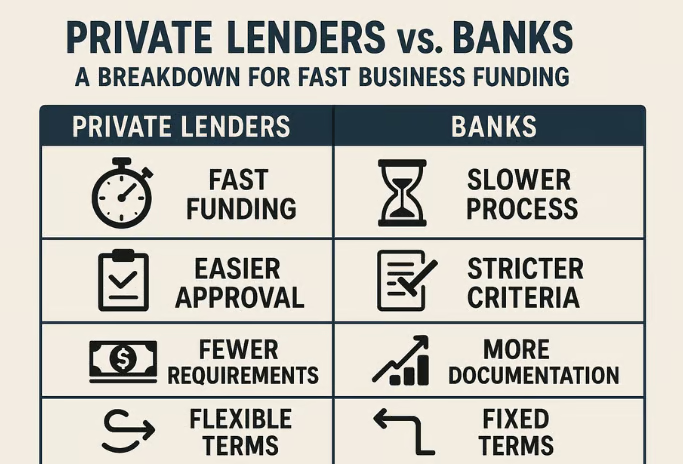
If you decide to seek financing for this purchase order, a traditional commercial bank will likely frustrate you.
When a seasonal rush or a massive contract appears, the window of opportunity is extremely tight. Your supplier needs the deposit this week to guarantee the stock. A traditional bank process involves a human credit committee, weeks of waiting, and demands for physical property as collateral.
By the time the bank agrees to finance your inventory, the supplier has already sold those goods to a competitor who had cash ready.
Secure Capital and Protect Your Reserves
At BusinessFunds, we operate differently. We are a matching engine built to connect active South African businesses with fast, unsecured capital.
Our lending partners understand that when you have a confirmed order, you need stock finance immediately, not next month. By linking securely to your trading history, they can assess your business health and approve your funding in hours.
You do not need to sign away your house, and you do not need to drain your hard-earned cash reserves. If you have been trading for over a year and generate at least R50,000 in monthly turnover, you have options.
Treat your cash reserve with respect. Keep it where it belongs, and use strategic capital to fund your heavy lifting.
Keep Your Cash. Fund Your Growth.
Are you about to drain your operational bank account to fulfill a big order? Stop and protect your business. Use our platform to secure the stock finance you need in as little as 24 hours.
Need Startup Capital?
If your business is already trading, check your eligibility for up to R5M in unsecured funding.
Check Eligibility