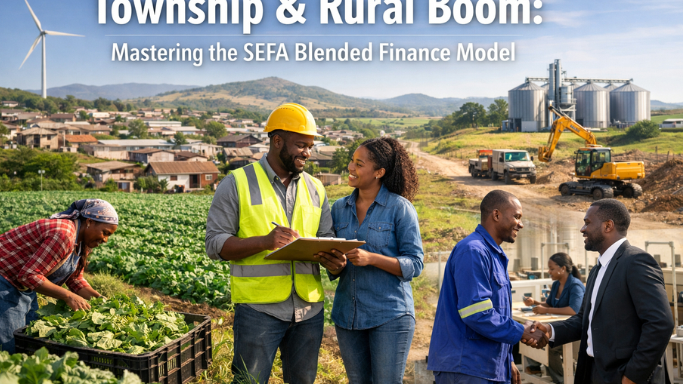
By 2026, the South African government will have consolidated much of its support into the Township and Rural Entrepreneurship Programme (TREP). The old days of 100% free grants with no strings attached are mostly gone. Today, the focus is on Blended Finance, and if you understand how to navigate it, you can unlock up to R1 million for your business.
What is Blended Finance?
Think of Blended Finance as a “hybrid” deal. In the current TREP framework:
-
The Grant Component: Typically 50% of the total amount (capped at R100,000 for most sub-schemes). You do not pay this back.
-
The Loan Component: The remaining amount is a loan with a fixed interest rate (often around 5%) to be repaid over 36 to 60 months.
This structure is designed to prove to the government that your business is commercially viable—it generates enough profit to pay back the loan portion, while the grant portion lowers your overall risk.
Stop guessing. Start building.
We've built a free Business Idea Generator Tool that walks you through this exact framework and generates a professional Validation Report.
Access the Free ToolWho is this for? (The 2026 Focus Sectors)
TREP isn’t open to everyone. It is highly targeted at sectors that keep money circulating within the community. The 2026 priority list includes:
-
Manufacturing & Localisation: Small-scale clothing, furniture making, and “Township Tech” (like IoT repair or e-waste recycling).
-
Bakeries & Confectioneries: Supporting local food security.
-
Automotive Aftermarket: Mechanics, panel beaters, and small auto-spares shops.
-
Butcheries & Cooked Food: Upgrading hygiene and cold storage for local food businesses.
-
Personal Care: Support for salons and barber shops to formalise and upgrade equipment.
The Application Blueprint
To get your application approved by the Small Enterprise Finance Agency (SEFA), you must demonstrate three things:
1. 70% Local Employment
A strict requirement for 2026 is that at least 70% of your employees must be South African citizens. If you employ non-nationals, they must have valid work permits.
2. The Municipal Trade Permit
You cannot get this funding without being “legal” in your local municipality. You must have a valid business license or trade permit.
-
Note: If you don’t have one yet, SEDA (Small Enterprise Development Agency) often provides “non-financial support” to help you get this compliance before you apply for the money.
3. The “Supplier Direct” Payment
SEFA rarely puts R1 million into your personal bank account. They use a Supplier-Direct Payment system.
Free Tools Mentioned
Access our interactive calculators to simulate your specific business numbers.
Unlock All Tools Free-
How it works: You provide quotes from reputable suppliers. Once approved, SEFA pays the supplier directly for your machines or stock. This prevents fraud and ensures the money is used for the business.
Use the SMME Database
The portal at SMME.gov.za is your “Golden Ticket.” In 2026, all government funding agencies—including the National Youth Development Agency (NYDA) and the National Empowerment Fund (NEF)—use this central database to verify your details. If your profile there isn’t 100% complete, your application will be ignored.
Need Startup Capital?
If your business is already trading, check your eligibility for up to R5M in unsecured funding.
Check Eligibility