It’s one of the most frustrating experiences for a small business owner.
Your business is doing well. You have happy customers (maybe you’re an online piano teacher with a full schedule or a café with a loyal morning rush). You know that with a small cash injection, you could really grow. But when you apply for a loan, you get a quick, cold “no.”
What went wrong?
Often, the problem isn’t your business; it’s your “funding readiness.” Lenders, especially modern ones, make decisions based on data. If your data is messy, incomplete, or mixed up with your personal life, they can’t see your business’s true health.
Stop guessing. Start building.
We've built a free Business Idea Generator Tool that walks you through this exact framework and generates a professional Validation Report.
Access the Free Tool“Funding readiness” is the process of getting all your business’s financial and legal “ducks in a row” before you apply. It’s the single most important hurdle to clear, and this guide is your 5-step checklist to do it.
What is “Funding Readiness” (And Why Is It Such a Hurdle)?
“Funding readiness” is simply the state of having all your business’s information organised in a way that is professional, verifiable, and easy for a lender to analyse.
Why is it a hurdle? Most entrepreneurs are busy being experts at their craft, not at bookkeeping. You’re focused on teaching lessons, serving customers, or coding your product. Admin and finances often become an afterthought—a shoebox of receipts and a messy bank statement.
-
Traditional Banks see this as a lack of professionalism and risk.
-
Modern Fintech Lenders simply can’t analyse your data. Their AI-driven scoring models need clean, digital data to work.
By getting “funding ready,” you are translating your hard work into a language that lenders can understand and trust.
The 5-Step Funding Readiness Checklist
Follow these steps, and you will be in the top 10% of prepared loan applicants.
Free Tools Mentioned
Access our interactive calculators to simulate your specific business numbers.
Unlock All Tools FreeStep 1: Separate Your Finances (The #1 Rule)
This is the most common and most damaging mistake. If you are running your business—even an online side-hustle—from your personal bank account, stop today.
-
Why? A lender cannot tell the difference between your business revenue and a birthday gift from your aunt, or between a business expense (like new keyboards) and your personal grocery shopping. It makes your cash flow impossible to analyse.
-
Your Action: Open a dedicated business bank account. All business income must go in, and all business expenses must go out of this account. This is non-negotiable.
Step 2: Digitise Your Records (Speak the Lenders’ Language)
Cash is invisible to a digital lender. Invoices saved as Word documents are weak proof. To prove your business is real and healthy, you must create a clear digital data trail.
-
Why? This digital data is what modern AI-driven lenders use for credit scoring. Clean data is the key to unlocking these new, faster funding options.
-
Your Action:
-
Payments: Use a digital payment gateway (like PayFast) or a Point-of-Sale (POS) system (like Yoco). This creates a verifiable record of every sale.
-
Invoicing: Use digital accounting or invoicing software (like Xero, Sage, or even free tools like Wave or InvoiceNinja). This shows lenders who your clients are and how they pay.
-
Step 3: Know Your (Real) Numbers
“Feeling” profitable isn’t enough. You need to know your exact numbers. This is what lenders look at to determine if you can afford to repay the loan.
-
Why? Lenders need to see your operational health at a glance. “Management Accounts” are the simple, internal reports that show this.
-
Your Action: Have these three things ready (your accounting software can generate them):
-
Profit & Loss Statement (P&L): A simple report showing your Revenue – Expenses = Profit (or Loss) for the last 6-12 months.
-
Balance Sheet: A snapshot of your business’s Assets (what you own) and Liabilities (what you owe).
-
Cash Flow Forecast: A simple 12-month projection of cash coming in and cash going out. This shows the lender you’ve planned for how to handle the repayments.
-
For a great, simple overview of these, check out this guide to management accounts from Xero.
Step 4: Get Your Compliance in Order
Lenders will not give money to an “informal” or non-compliant business. This is a quick check to see if you are a legitimate, formal entity.
-
Why? It proves your business is real, in good standing with the government, and paying its taxes.
-
Your Action: Have these two documents ready and up-to-date:
-
CIPC Registration: Your formal business registration documents.
-
SARS Tax Clearance Certificate: A valid (not expired) certificate showing your tax affairs are in order.
-
Step 5: Define the “Why” and “How Much”
Lenders are investing in a plan, not just giving you cash. You must have a clear, logical answer to two questions: “How much do you need?” and “What will you use it for?”
-
Why? A clear plan shows you are a strategic business owner, not a desperate one. It allows the lender to assess the risk and return of the loan.
-
Your Action: Write a single paragraph that explains your plan.
-
Bad Answer: “I need R50,000 for my business.”
-
Good Answer: “I am requesting R50,000. R30,000 will be used to purchase 5 new professional keyboards to double my student capacity. R20,000 will be used for a 3-month digital marketing campaign to find new students, which I project will lead to 20 new clients and R25,000 in new monthly revenue.”
-
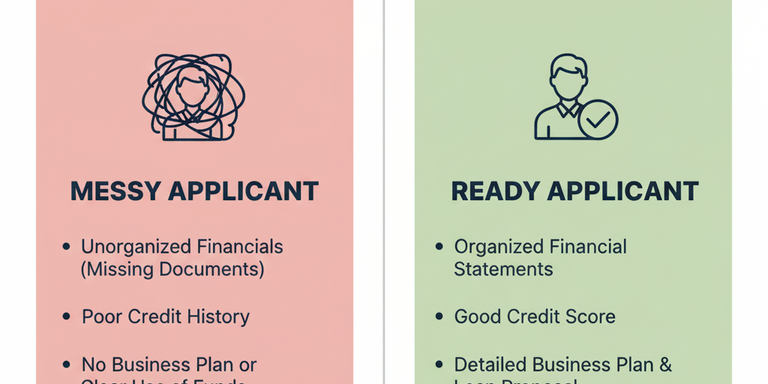
Being “Ready” is the Key to Bridging the Funding Gap
This might seem like a lot of admin, but this preparation is the single biggest factor you can control.
In fact, this checklist is the exact solution to the “Micro-Business Funding Gap” in South Africa. Lenders want to fund small businesses, but they can’t if the business’s information is a mess.
By getting “funding ready,” you are no longer a “risk” to a lender; you are an “opportunity.” You are making it easy for them to say yes.
Need Startup Capital?
If your business is already trading, check your eligibility for up to R5M in unsecured funding.
Check Eligibility