
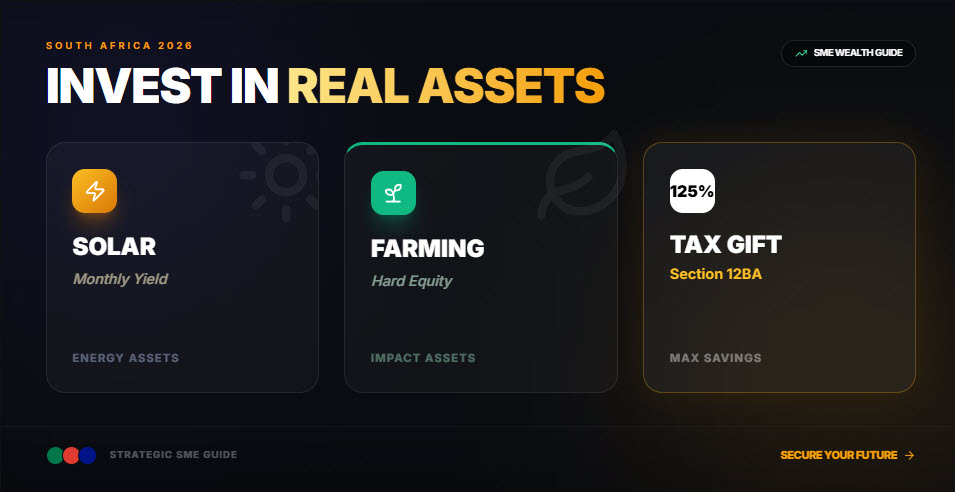
In the current economic climate, the old rules of “stocks and bonds” aren’t enough. South African business owners are now looking for assets that solve real-world problems—like energy shortages and food security—while providing a steady monthly yield.
Solar Cells: The “Sun Exchange” Model
With electricity costs continuing to climb in 2026, renewable energy is no longer just “green”—it’s a high-yield financial asset.
-
How it works: Through platforms like Sun Exchange, you buy individual solar cells. These cells are then installed on the roofs of schools, retirement homes, or factories across South Africa.
-
The Income: The school or factory pays you for the electricity the cells produce. You receive a monthly stream of income (often in Rands or Bitcoin) for the 20-year lifespan of the project.
-
The 2026 Advantage: This is a “set and forget” investment. The platform handles all the maintenance and insurance; you simply collect the “rental” from the sun.
Impact Farming: Owning the “Means of Production”
Through the Fedgroup App, SMEs can now diversify into agriculture without ever touching a tractor.
Stop guessing. Start building.
We've built a free Business Idea Generator Tool that walks you through this exact framework and generates a professional Validation Report.
Access the Free Tool-
The Assets: You can buy physical assets like Blueberry Bushes, Macadamia Trees, Beehives, or even Solar Panels.
-
The Cycle: You pay for the asset (e.g., R80 for a blueberry bush). Fedgroup’s partner farmers grow, harvest, and sell the produce. You receive a share of the profit at every harvest.
-
Why SMEs love it: It’s an “inflation-hedged” investment. If the price of food goes up, your investment return usually goes up too.
The 125% Tax “Gift”: Section 12BA
This is the single most important tax hack for South African business owners in 2026. The government has extended the Section 12BA (formerly 12B) incentive to encourage private energy production.
-
The Rule: If your business invests in qualifying renewable energy assets (like solar panels or wind turbines), you can claim a 125% tax deduction in the first year.
-
The Math: If your business buys R100,000 worth of solar assets, you can deduct R125,000 from your taxable income. At a corporate tax rate of 27%, this effectively “pays back” a huge chunk of your investment via tax savings immediately.
-
Note: Always check with your tax practitioner, as there are specific rules about when the asset must be “brought into use.”
Private Debt & SME Credit Funds
In 2026, traditional banks are still slow to lend. This has created a massive market for “Private Debt.”
-
How it works: Instead of a bank lending to a growing company, you (via a fund manager like Momentum Alternative Investments or Ninety One) lend your surplus cash to other high-growth SMEs.
-
The Return: These funds often target returns of CPI + 5% or 7%, which is significantly higher than a business savings account.
-
The Risk: Unlike a fixed deposit, your capital isn’t 100% guaranteed, but it is diversified across hundreds of different loans to reduce risk.
Pros and Cons of Real Assets
The Good:
-
Hard Assets: You own something physical that has value even if the stock market crashes.
-
Social Impact: You are literally creating jobs, supporting farmers, and powering schools.
-
Low Correlation: These assets don’t move in sync with the JSE (Johannesburg Stock Exchange).
The Bad:
-
Liquidity: You cannot “sell” a macadamia tree or a solar cell instantly like you can a share. These are typically 5 to 20-year commitments.
-
Nature Risk: In farming, a bad drought or a hailstorm can lower your harvest yield for that year.
The “Portfolio of the Future”
A smart 2026 investment strategy for an SME doesn’t choose just one. It looks like this:
-
60% Cash: For your daily operations and emergencies.
-
20% Real Assets: Solar and Farming for long-term, tax-efficient yields.
-
20% Private Debt: For high-interest monthly returns.
Ready to turn your tax bill into a solar farm? 👇 Explore Fedgroup Impact Farming or Sun Exchange
Free Tools Mentioned
Access our interactive calculators to simulate your specific business numbers.
Unlock All Tools FreeNeed Startup Capital?
If your business is already trading, check your eligibility for up to R5M in unsecured funding.
Check Eligibility